
The best community marketing doesn’t feel like marketing at all—it feels like help from someone who genuinely knows what they’re talking about.
That’s the paradox brands struggle with. They want the benefits of community presence—trust, credibility, organic recommendations—but they keep creating content that screams “I’m trying to sell you something.” And communities can smell that desperation from miles away.
The solution isn’t better disguise. It’s genuinely changing your approach so that marketing becomes indistinguishable from helpfulness.
Why Traditional Marketing Fails in Communities
Traditional marketing operates on interruption and persuasion. You capture attention, deliver a message, and try to convince people to take action. The relationship is fundamentally adversarial—you want their money; they want to protect their wallet.
Communities reject this model completely.
When someone joins a subreddit or forum, they’re not looking to be marketed to. They’re looking for connection, information, and help from people who share their interests. Commercial messaging violates the implicit social contract of the space.
This is why brands that bring traditional marketing tactics to communities fail so spectacularly. They’re playing by rules that don’t apply, and community members punish them for it.
The brands that succeed understand something different: in communities, the path to commercial success runs through genuine helpfulness. You can’t persuade your way to trust. You have to earn it.
The Mindset Shift Required
Effective community marketing strategy requires changing how you think about the relationship between your business and potential customers.
From extraction to contribution. Traditional marketing asks: “How do we get value from these people?” Community marketing asks: “How do we provide value to these people?”
From messages to conversations. Traditional marketing broadcasts; community marketing participates. You’re not delivering content at an audience—you’re joining discussions as a peer.
From campaigns to presence. Traditional marketing runs in defined time periods with clear starts and ends. Community marketing is ongoing participation that builds over months and years.
From control to authenticity. Traditional marketing carefully crafts every message. Community marketing requires genuine, human responses that can’t be scripted in advance.
From metrics to relationships. Traditional marketing obsesses over impressions and clicks. Community marketing values trust built and relationships formed.
This isn’t just a tactical shift—it’s a philosophical one. Until you genuinely adopt this mindset, your community presence will always feel like marketing in disguise.
Building a Strategy That Serves First
Here’s how to create a community marketing strategy that doesn’t trigger people’s marketing defenses:
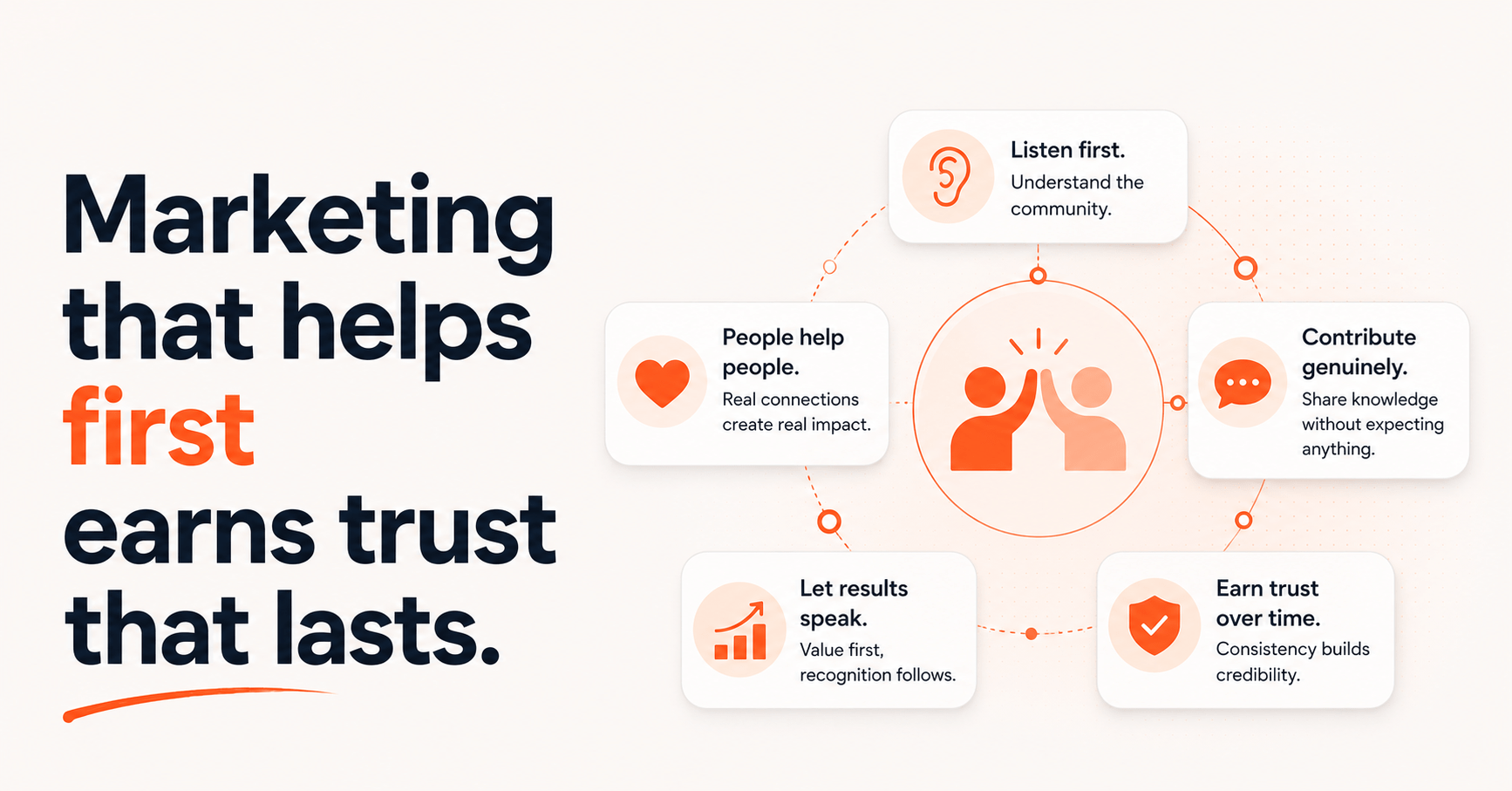
Start With Listening
Before contributing anything, spend weeks just observing. What questions come up repeatedly? What frustrates community members? What do they celebrate?
What makes them skeptical?
This listening period serves two purposes. First, it helps you understand the community well enough to contribute meaningfully. Second, it reveals opportunities where your expertise can genuinely help.
The goal isn’t finding promotional opportunities. It’s understanding what the community needs.
Define Your Genuine Expertise
What do you actually know that could help people? Not “what do we want to tell people about our product”—what genuine expertise do you have that addresses problems community members face?
This might be broader than your product. If you sell mattresses, your expertise might include sleep science, bedroom environment optimization, or how to evaluate any mattress (including competitors). If you sell project management software, your expertise might include productivity methods, team communication, or managing remote work.
Your expertise is the foundation of your contribution. It’s what makes you valuable to the community independent of any commercial interest.
Create Value Without Expectation
Here’s the hard part: you need to help people without expecting anything in return. Not “help people and then pitch them.” Actually help them, period.
When someone asks a question you can answer, answer it completely. Don’t hold back the good stuff hoping they’ll pay for it later. Don’t add a pitch at the end. Just help.
This feels counterintuitive to most marketers. We’re trained to always include a call to action, to never give away value without getting something back. But in communities, giving without expectation is exactly what builds the trust that eventually converts.
Let Results Speak
When your contributions are genuinely helpful, something interesting happens: people start checking your profile. They want to know who this helpful person is. And if your profile includes your business connection, some percentage will explore further.
This is completely different from pitching. You’re not pushing information at people—they’re pulling it because you’ve earned their curiosity. The conversion happens because of your demonstrated expertise, not despite your lack of promotion.
Mention Products Only When Genuinely Relevant
Sometimes your product really is the best answer to someone’s question. In those cases, you can mention it—but the context matters enormously.
Before mentioning your product, ask yourself: Would I recommend this even if I didn’t work for this company? Is this genuinely the best solution for this person’s specific situation? Have I provided enough non-commercial value in this community that a product mention won’t damage my credibility?
If you can honestly answer yes to all three, a product mention is appropriate. Frame it as one option among several when possible. Acknowledge limitations. Be helpful first and promotional last.
The 90/10 Framework
A useful rule of thumb: 90% of your community activity should be purely helpful with zero commercial intent. Only 10% can include any mention of your product or business.
Some successful community marketers operate at even higher ratios—95/5 or 99/1. The more generous you are with non-commercial helpfulness, the more credibility you have when commercial mentions do occur.
This ratio should apply both to individual conversations and to your overall participation pattern. If your last ten comments all mentioned your product, you’ve blown the ratio badly regardless of how helpful each individual comment was.
Content Types That Don’t Feel Promotional
Certain types of content naturally feel helpful rather than promotional:
Answering questions thoroughly. When someone asks how to solve a problem, give them a complete answer. Include context, alternatives, and considerations they might not have thought of.
Sharing experiences honestly. “Here’s what happened when I tried X” is more trustworthy than “X is the best option.” Include failures and lessons learned.
Providing frameworks. Help people think through decisions rather than telling them what to decide. “Here are the factors to consider when choosing a mattress” is more valuable than “Buy this mattress.”
Acknowledging complexity. Real problems rarely have simple answers. Recognizing nuance and tradeoffs demonstrates genuine expertise rather than marketing simplification.
Recommending competitors when appropriate. Nothing builds credibility faster than honestly recommending a competitor when they’re the better fit. It signals that you care about helping more than selling.
What to Avoid
Some approaches always feel like marketing, no matter how you dress them up:
Leading with your product. If your contribution starts with or primarily focuses on your product, it’s promotion regardless of how much helpful context you add around it.
Generic responses that could apply anywhere. Helpful contributions are specific to the question asked and the person asking. Template responses signal that you’re not really engaged.
Showing up only when promotional opportunities exist. If you only appear when someone asks for product recommendations, your pattern betrays your intent.
Corporate voice. Marketing speak triggers instant skepticism. Conversational, human language is essential.
Excessive positivity about your product. Real users acknowledge limitations. Unqualified enthusiasm signals bias.
Measuring Success Differently
Traditional marketing metrics don’t capture community marketing’s value. Here’s what to track instead:
Reputation indicators. Are your contributions getting upvoted? Are people thanking you for help? Are community members recognizing your username positively?
Unprompted mentions. Are other community members recommending you in threads where you haven’t participated? This is the ultimate indicator of earned trust.
Engagement quality. Are people responding to your contributions with follow-up questions and substantive discussion? This indicates genuine value.
Profile visits. Are people curious enough about you to check who you are? This shows you’ve earned attention rather than demanded it.
Relationship development. Are you building ongoing relationships with community members? Do people seek out your input?
These indicators matter more than impressions or clicks because they measure trust—the actual goal of community marketing.
Ready to build a community marketing strategy that actually works?
At Agence Paradis, we’ve spent over three years developing community marketing strategy that builds genuine trust. Our approach has helped partners in the sleep and health industries generate over $10 million in additional revenue—not through aggressive promotion, but through authentic helpfulness that earns recommendations.
We’ll help you identify where your expertise can genuinely help your target community and build a presence that drives results without triggering marketing resistance.
Get your free community audit at agenceparadis.com

Leave A Comment