
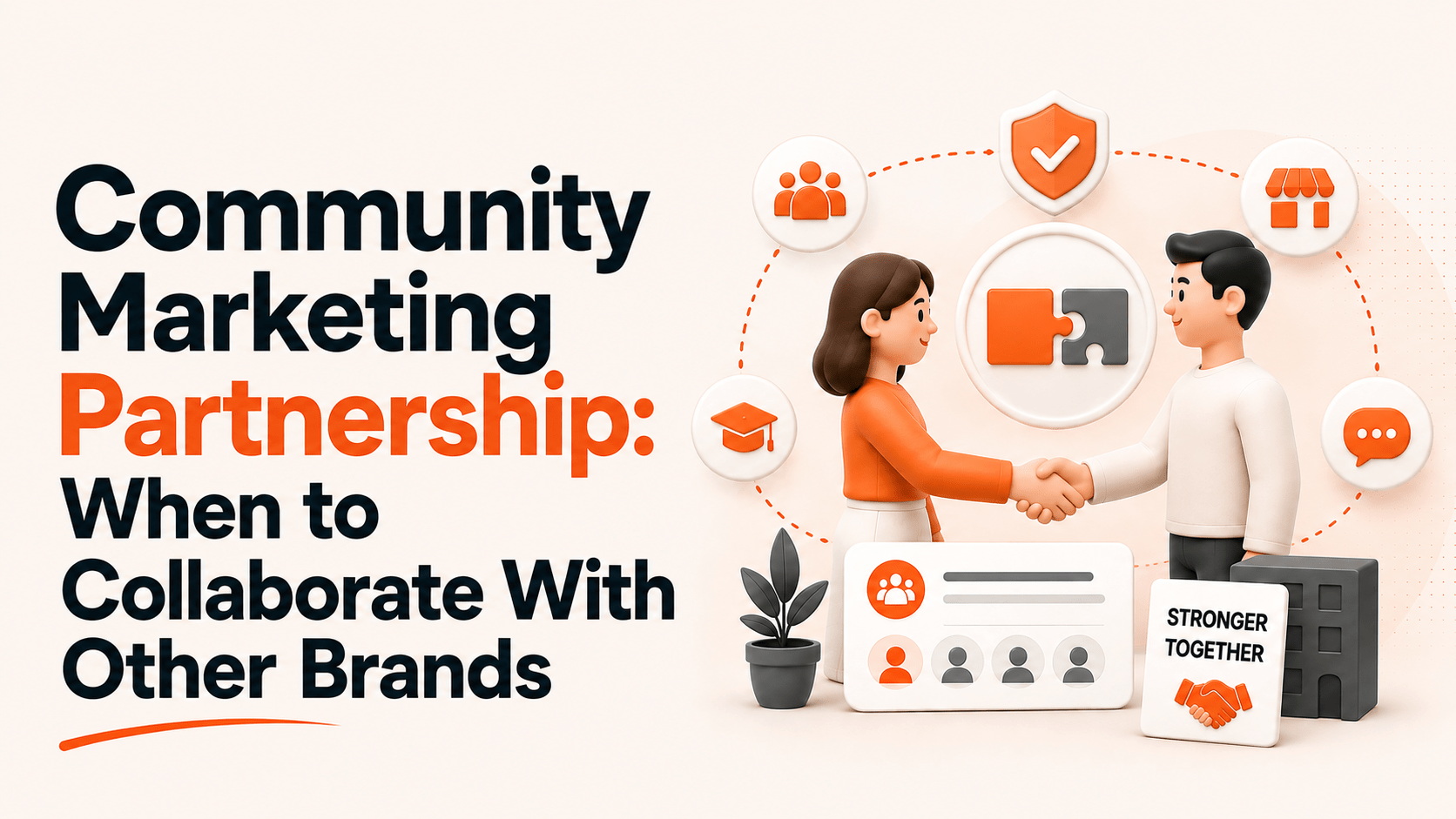
Two brands helping the same community can accomplish more together than separately—if the partnership is structured right and executed authentically.
Community marketing partnerships happen when brands with complementary offerings collaborate in shared communities. Done well, these partnerships expand reach, share credibility, and create value neither brand could provide alone. Done poorly, they look like coordinated marketing schemes and trigger community backlash.
Here’s how to identify partnership opportunities and execute them in ways communities will actually appreciate.
What Community Marketing Partnerships Look Like
Effective partnerships take several forms:
Complementary expertise sharing: Brands contribute different knowledge to the same discussions. A mattress company and a sleep app company might both participate in sleep communities, each adding expertise the other lacks.
Joint content creation: Brands collaborate on genuinely useful content—guides, comparisons, resources—that serves community needs better than either could create alone.
Cross-community introductions: Brands established in different communities introduce each other, lending credibility in new spaces.
Coordinated problem-solving: When community members have problems spanning multiple product categories, partner brands can provide comprehensive solutions together.
Mutual recommendation: Brands recommend each other where genuinely relevant, expanding reach through authentic endorsement.
Identifying Good Partnership Candidates
Not every brand makes a good partner. Look for:
Complementary, Not Competing
Partners should serve the same audience with different offerings. A mattress company partnering with another mattress company creates awkwardness. A mattress company partnering with a pillow company, sleep tracker, or bedroom furniture brand creates complementary value.
Shared Values and Approach
Partners should have similar community engagement philosophies. If you prioritize authentic helpfulness and your potential partner uses aggressive promotional tactics, the partnership will feel disjointed and may damage your reputation.
Established Community Presence
Ideal partners already have credibility in communities you want to reach. Partnering with a brand that’s unknown or distrusted doesn’t help you—it may hurt you through association.
Genuine Product Compatibility
Your offerings should actually work well together. Communities will notice if you’re recommending each other’s products without genuine compatibility. The partnership has to make sense for customers, not just for marketing.
Cultural Fit
Brand personalities should complement each other. Professional and casual can work together. Aggressive and gentle typically can’t.
Partnership Models That Work
Several partnership approaches succeed in community contexts:
The Expertise Exchange
Each brand contributes knowledge in their specialty area to help community members with complex problems.
- How it works: When a question spans both brands’ expertise—like “how do I set up my bedroom for better sleep?”—both brands contribute their piece. The mattress expert discusses surface and support; the smart home brand discusses lighting and temperature control.
- Why it works: The combined answer is more valuable than either could provide alone. Community members appreciate comprehensive help.
- Key to success: Contributions should be genuinely collaborative, not separate pitches awkwardly combined.
The Joint Resource
Brands collaborate on creating genuinely useful content that neither would create alone.
- How it works: Partners co-create a guide, comparison framework, or resource that draws on both brands’ expertise. This gets shared organically when relevant to community questions.
- Why it works: The resource provides real value. Community members share and reference it because it’s helpful.
- Key to success: The resource must be genuinely useful, not a disguised marketing piece. If it reads like a joint sales pitch, it will be rejected.
The Mutual Endorsement
Brands recommend each other where genuinely relevant to community questions.
- How it works: When someone asks a question outside your expertise but within your partner’s, you refer them to your partner. Your partner does the same. These referrals are genuine recommendations, not coordinated marketing.
- Why it works: Referrals from trusted community members carry weight. If you’ve built credibility, your endorsement helps your partner.
- Key to success: Endorsements must be genuinely relevant and earned. Forced or inappropriate referrals damage both brands.
The Cross-Community Introduction
An established brand vouches for a partner in communities where the partner is new.
- How it works: If you’re established in Community A and your partner wants to enter, you can mention their helpfulness from your experience. If your partner is established in Community B, they can do the same for you.
- Why it works: New entrants to communities start with credibility deficits. Endorsement from known trusted members accelerates trust-building.
- Key to success: The endorsement must be genuine. Don’t vouch for a partner until they’ve proven themselves in other contexts.

Structuring the Partnership
Before engaging, establish clear agreements:
Define Boundaries
- Which communities will each brand focus on?
- How will overlapping situations be handled?
- What topics does each brand own?
- What are the limits of mutual endorsement?
Align on Approach
- What’s the shared philosophy about promotional content?
- How will criticism of either brand be handled?
- What voice and tone standards apply?
- How will you handle disagreements?
Establish Communication
- How frequently will partners sync?
- Who are the primary contacts?
- How are opportunities shared?
- How are problems escalated?
Plan for Problems
- What happens if one brand damages its reputation?
- How do you handle criticism of the partnership itself?
- What’s the exit process if the partnership isn’t working?
- How do you avoid looking like coordinated marketers?
Avoiding Partnership Pitfalls
Community marketing partnerships can backfire:
The Coordinated Marketing Problem
Communities are suspicious of anything that looks like coordinated marketing. If your partnership appears to be brands working together to promote each other, it will be treated as manipulation.
How to avoid: Keep partnerships visible but not promotional. Contribute genuine value. Don’t time promotional mentions. Let recommendations emerge naturally.
The Association Risk
Your reputation becomes linked to your partner’s. If they behave badly, it reflects on you.
How to avoid: Choose partners carefully. Monitor their community presence. Have exit plans if their approach changes.
The Scope Creep Problem
Partnerships that start with genuine collaboration can drift toward coordinated promotion as pressure for results increases.
How to avoid: Establish clear guidelines about promotional ratios. Revisit these regularly. Hold each other accountable.
The Competition Evolution
Today’s complementary partner might become tomorrow’s competitor through product expansion.
How to avoid: Include competition scenarios in partnership agreements. Define what happens if one brand enters the other’s category.
Measuring Partnership Success
Track metrics that indicate partnership health:
Individual contribution quality: Is each brand maintaining its own reputation for helpfulness?
Combined reach: Are you reaching communities you couldn’t reach alone?
Endorsement reception: When you recommend your partner, how is it received?
Community perception: Does the community view your partnership positively or suspiciously?
Referral quality: Are partner-referred customers good fits for your product?
Value creation: Are you creating content or solutions together that neither could create alone?
When Partnerships Don’t Make Sense
Some situations are better handled independently:
When credibility is fragile: If you’re still building community trust, partnerships add complexity. Establish independent credibility first.
When partner fit is unclear: If you’re not sure the partnership genuinely benefits customers, don’t force it.
When promotional pressure is high: Partnerships under pressure to deliver quick results tend to become promotional schemes.
When values don’t align: Better to go alone than partner with a brand whose approach will damage your reputation.
Looking for authentic community marketing partnerships?
At Agence Paradis, we help brands identify and execute community marketing partnerships that create genuine value. Our approach ensures partnerships look like helpful collaboration, not coordinated marketing.
Our partners in the sleep and health industries have generated over $10 million in additional revenue through community presence—sometimes enhanced by thoughtful partnerships with complementary brands. We’ll help you determine whether partnerships make sense for your situation and how to structure them for success.
Get your free partnership assessment at agenceparadis.com

Leave A Comment