
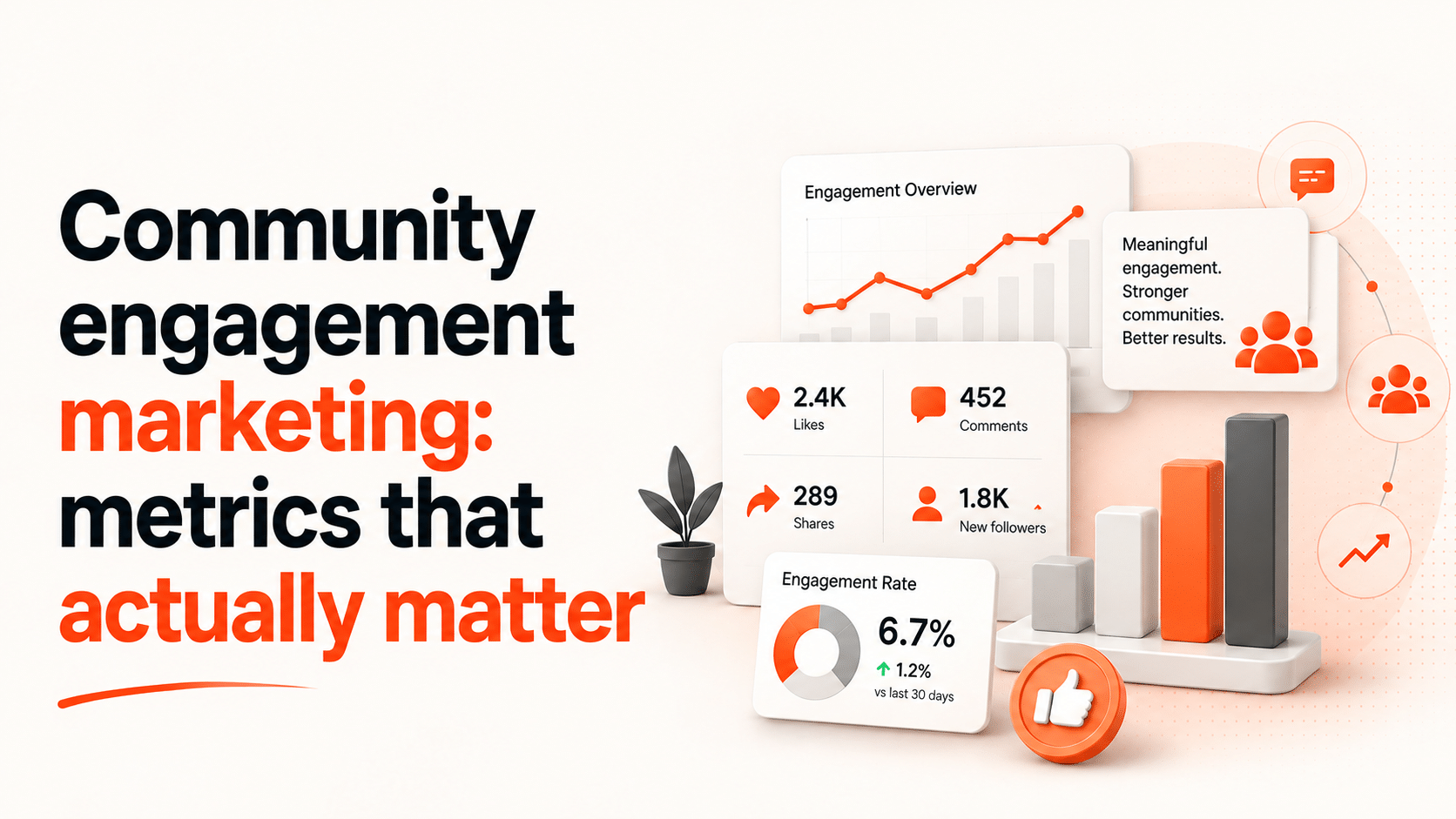
Most community engagement metrics measure activity, not impact. You can have thousands of comments and zero business results. Knowing which metrics actually predict success changes everything.
The vanity metrics that look impressive in reports often have no correlation with revenue, customer acquisition, or brand growth. Meanwhile, the metrics that matter are frequently ignored because they’re harder to track and slower to move.
Here’s what to actually measure—and what to stop measuring.
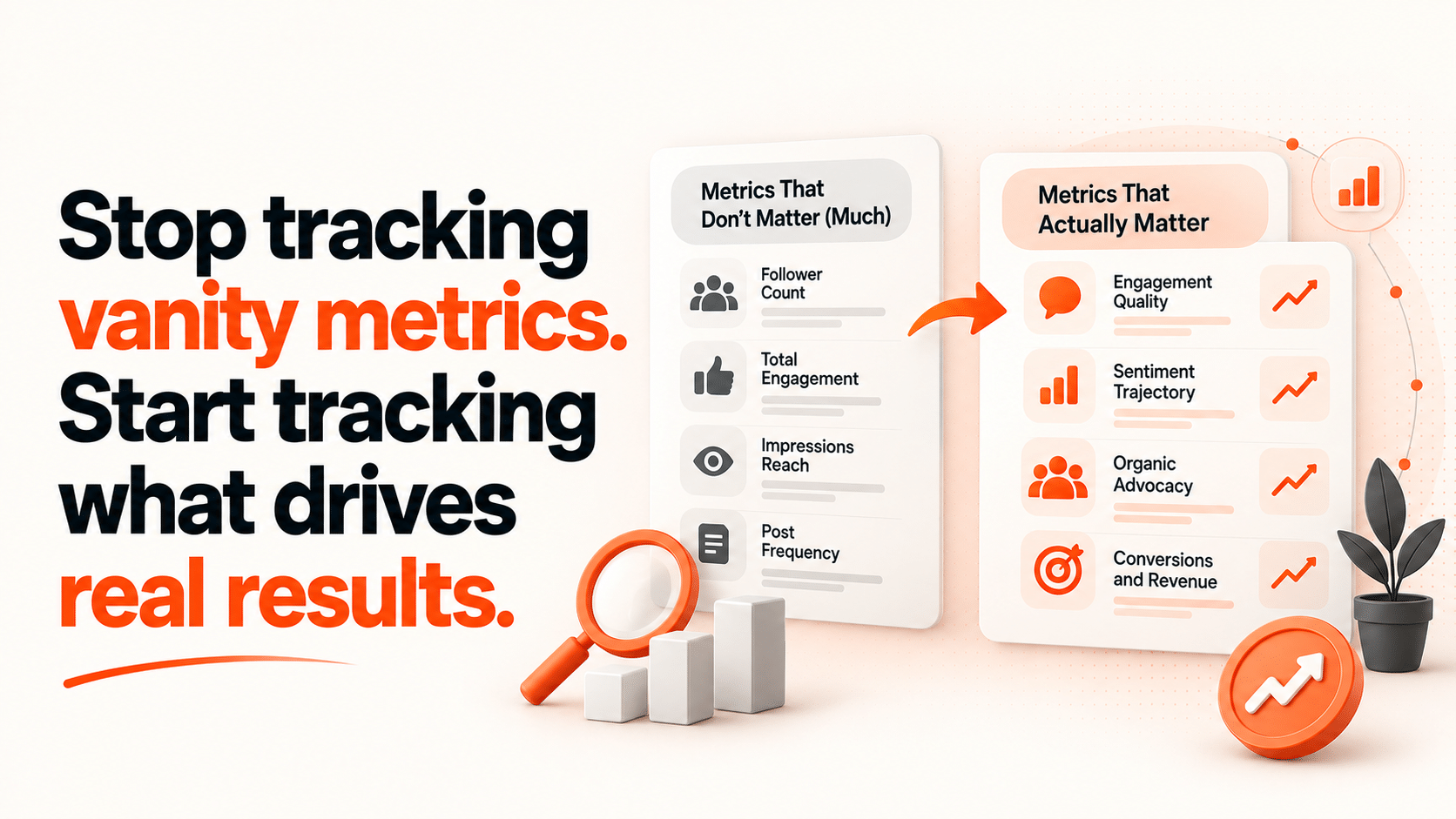
Metrics That Don’t Matter (Much)
These metrics feel important but often mislead:
Follower/Member Count
A large community doesn’t equal an engaged community. You can have 50,000 members with minimal activity, or 500 highly engaged people driving real results.
- Why it’s misleading: Growth hacking tactics inflate this number without creating value. Bot accounts, inactive members, and people who joined years ago and forgot about you all count the same.
- When it matters: Only as a rough baseline for reach potential. A community of 100 caps your potential differently than one of 100,000.
Total Engagement Volume
Raw counts of comments, likes, or interactions look good on reports but hide quality issues.
- Why it’s misleading: Ten low-quality comments don’t equal one thoughtful response. Controversy and complaints generate engagement too. Activity can be high while impact is zero.
- When it matters: Significant drops signal problems. Trends matter more than absolute numbers.
Impressions/Reach
How many people theoretically saw your content rarely correlates with how many people were influenced by it.
- Why it’s misleading: Scrolling past something counts as an impression. Platforms inflate these numbers because they benefit from making activity seem larger.
- When it matters: Useful for understanding distribution mechanics, not for measuring actual impact.
Post Frequency
Publishing more content feels productive but doesn’t guarantee results.
- Why it’s misleading: Quality matters far more than quantity. Posting frequently with mediocre content often performs worse than posting occasionally with exceptional content.
- When it matters: As a minimum threshold. Posting zero is different from posting daily, but the difference between daily and three times weekly is often negligible.
Metrics That Actually Matter
Focus measurement on these indicators:
Engagement Quality
Not all engagement is equal. Measure the quality of interactions:
- Response depth: Are people writing thoughtful responses or just “nice post”? Longer, more substantive comments indicate genuine engagement.
- Conversation generation: Does your content spark discussion between community members, or does engagement stop at responding to you?
- Question quality: Are people asking sophisticated follow-up questions that demonstrate genuine interest and understanding?
- How to measure: Manual assessment of representative samples. Track average response length. Count multi-comment threads versus single responses.
Sentiment Trajectory
Is community perception of your brand improving, staying flat, or declining?
- Positive indicators:
- Increasing unsolicited positive mentions
- More balanced response to criticism (community members defending you)
- Tone of discussion becoming more favorable
- Negative indicators:
- Increasing criticism frequency
- Positive mentions declining
- Community members piling on rather than defending
- How to measure: Regular sentiment analysis (manual or tool-assisted). Track ratio of positive/neutral/negative mentions over time.
Organic Advocacy
Are community members recommending you without prompting?
- What to track:
- Mentions of your brand in threads where you haven’t participated
- Community members answering questions by recommending you
- Referral traffic patterns (are people arriving from community links you didn’t place?)
- How to measure: Monitor brand mentions. Track referral sources. Survey customers about how they heard about you.
Conversion Metrics
Ultimately, engagement should drive business results:
- Traffic attribution: How much website traffic comes from community sources?
- Conversion rate: Do community-referred visitors convert at different rates than other sources?
- Customer lifetime value: Are community-acquired customers worth more over time?
- How to measure: UTM tracking on links. Analytics setup for referral attribution. Cohort analysis comparing customer sources.
Community Health Indicators
Long-term community engagement requires healthy communities:
- Participation distribution: Are many people participating or just a few voices dominating?
- New member integration: Are new participants welcomed and successfully integrated?
- Retention patterns: Do members stay engaged over time or quickly disengage?
- How to measure: Track unique participants over time. Measure time from joining to first contribution. Monitor activity patterns of cohorts.
The Metrics Hierarchy
Structure measurement around a hierarchy:
Leading Indicators (Weekly Tracking)
Early signals that predict future results:
- Engagement quality scores
- Response sentiment
- Participation breadth
- New relationship development
These move before business results and help you adjust early.
Progress Indicators (Monthly Tracking)
Evidence that your approach is working:
- Organic mention frequency
- Community sentiment trends
- Referral traffic growth
- Recognition level (are you becoming known?)
These confirm your leading indicators are translating to progress.
Outcome Indicators (Quarterly Tracking)
Actual business impact:
- Revenue attributed to community channels
- Customer acquisition cost comparison
- Lifetime value by acquisition source
- Brand perception metrics
These measure what ultimately matters.
Setting Up Measurement
Practical steps to track what matters:
Create a Monitoring System
- For brand mentions:
- Set up Reddit search alerts
- Monitor relevant subreddits daily
- Track mentions with simple spreadsheet logging
- For sentiment:
- Review representative samples weekly
- Categorize as positive/neutral/negative
- Track trends over time
- For traffic:
- Configure Google Analytics for Reddit referral tracking
- Use UTM parameters on any links you share
- Track conversion paths that include community touchpoints
Establish Baselines
Before trying to improve metrics, understand your starting point:
- What’s current sentiment toward your brand?
- How often are you mentioned organically?
- What traffic currently comes from communities?
- What’s engagement quality like on your contributions?
Improvement requires knowing where you started.
Define Success Thresholds
What would “good” look like?
- Target sentiment ratio (e.g., 60% positive, 30% neutral, 10% negative)
- Organic mention frequency goal (e.g., 5+ weekly mentions you didn’t prompt)
- Traffic targets (e.g., Reddit becomes top 5 referral source)
- Conversion benchmarks (e.g., community visitors convert at 2%+)
Clear targets help evaluate whether your efforts are working.
Review and Adjust Cadence
Create regular review rhythms:
- Weekly: Quick check on leading indicators. Are things trending correctly?
- Monthly: Deeper analysis of progress indicators. What’s working? What needs adjustment?
- Quarterly: Full assessment including business outcomes. Is the investment paying off?
Want help measuring community engagement marketing that actually matters?
At Agence Paradis, we focus on metrics that predict business results, not vanity numbers that look good in reports.
Our partners in the sleep and health industries have generated over $10 million in additional revenue—results we can demonstrate because we measured what matters from the start. We’ll help you set up tracking that proves ROI.
Get your free metrics assessment at agenceparadis.com








Leave A Comment