
Criticism in community spaces can make or break your reputation. Most brands handle it wrong—either too defensive or too apologetic. The right response turns critics into advocates.
How you respond to criticism matters more than the criticism itself. Communities watch brand responses closely. A good response to harsh criticism builds more trust than a hundred positive interactions.
Here’s how to turn criticism into opportunity.
Why Criticism Response Matters Disproportionately
Visibility Amplification
Criticism gets attention. When someone calls out a brand, community members stop scrolling to watch. Your response has a larger audience than typical contributions.
Character Revelation
Anyone can be gracious when praised. How you handle criticism reveals character. Communities judge brands by how they respond to their worst moments, not their best.
Narrative Control
Your response shapes how the criticism is perceived. A good response can reframe even valid criticism. A bad response confirms the critic’s worst characterization.
Memory Persistence
People remember how brands handled criticism long after they forget routine positive interactions. One bad response haunts you; one good response builds lasting goodwill.
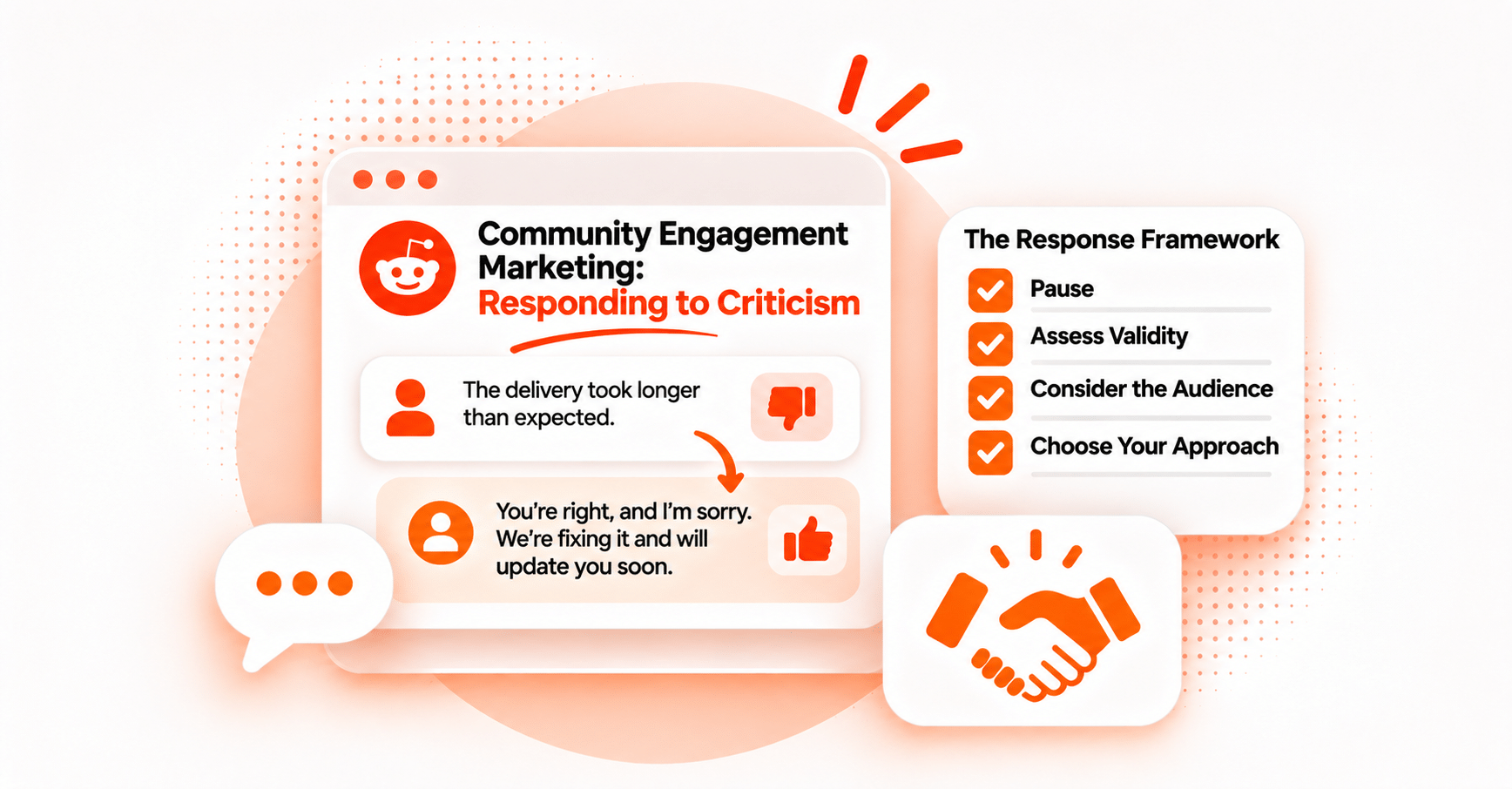
The Response Framework
Before responding to any criticism, work through this framework:
Step 1: Pause
Don’t respond immediately. Emotional reactions create problems.
- Wait at least:
- 5 minutes for minor criticism
- 30 minutes for significant criticism
- Several hours for major criticism or crises
Use this time to assess clearly, not craft defensive responses.
Be honest about whether the criticism has merit:
- Completely valid: They’re right. You failed them.
- Partially valid: Some points are accurate, but characterization is unfair.
- Factually incorrect: They’re wrong about the facts.
- Bad faith: They’re attacking, not critiquing.
Your assessment determines your response approach.
Step 3: Consider the Audience
You’re not just responding to the critic—you’re responding for everyone watching:
- What do observers expect you to say?
- What would build trust with neutral viewers?
- What would your best customers want to see?
- What would you respect if another brand said it?
Step 4: Choose Your Approach
Based on assessment, select response strategy (detailed below).
Response Strategies
For Valid Criticism: Full Acknowledgment
When they’re right, own it completely:
The formula:
- Acknowledge the valid point directly
- Apologize without qualifications
- Explain what you’re doing to fix it
- Offer to make it right
Example:
“You’re right, and I’m sorry. We dropped the ball on your order and the support experience made it worse. I’ve already escalated this internally. Can I DM you to get this resolved properly? We need to make this right.”
What makes this work:
- No defensiveness
- No excuses
- Concrete action
- Personal accountability
What to avoid:
- “I’m sorry you feel that way”
- “Our policy is…”
- “Actually, if you’d read…”
- “We were really busy when…”
For Partially Valid Criticism: Acknowledge Then Clarify
When they have a point but the framing is unfair:
The formula:
- Acknowledge what’s valid first
- Add context without being defensive
- Pivot to solving their actual problem
- Stay focused on their experience
Example:
“Fair point that shipping took longer than quoted—that’s on us. I’d add that we communicated the delay via email once we knew, but I understand that doesn’t fix the frustration of waiting. What can I do to make this better for you?”
What makes this work:
- Validates their frustration
- Adds context gently
- Doesn’t argue
- Focuses on resolution
What to avoid:
- Leading with “but actually”
- Making them wrong
- Lengthy self-defense
- Ignoring their valid point
For Factually Incorrect Criticism: Gentle Correction
When they’re wrong about the facts:
The formula:
- Assume good faith
- Correct gently with evidence
- Invite continued dialogue
- Don’t make them feel stupid
Example:
“I can see why you’d think that—our pricing page could definitely be clearer. What’s actually happening is [explanation]. Does that make more sense? Happy to clarify further if something still seems off.”
What makes this work:
- Assumes misunderstanding, not malice
- Provides clear correction
- Takes responsibility for confusion
- Invites dialogue
What to avoid:
- “That’s completely wrong”
- “If you’d actually read…”
- Condescension or mockery
- Public embarrassment
For Bad Faith Attacks: Strategic Non-Response
When criticism is trolling or coordinated attack:
The decision: Usually don’t respond. Engaging amplifies and rewards the attacker.
Exceptions:
- The attack is gaining traction and being believed
- Important facts need correcting for the audience
- Silence would be perceived as admission
If you must respond:
- Be brief and factual
- Correct only the most important errors
- Don’t engage emotionally
- Say it once and stop
Example:
“For anyone reading, this doesn’t match our records of what happened. Happy to discuss details with anyone who has questions.”
Common Mistakes
Mistake: Over-Apologizing
- Apologizing for things that aren’t your fault undermines legitimate apologies and makes you look weak.
- Instead: Apologize specifically for what you actually did wrong.
Mistake: Deflecting
- “That’s our vendor’s fault” or “Policy required us to…”
- Instead: Take responsibility for the customer experience regardless of internal causes.
Mistake: Corporate Voice
- “We sincerely apologize for any inconvenience caused…”
- Instead: Sound like a human being who actually cares.
Mistake: Going Silent
- Not responding to significant criticism suggests you don’t care or can’t defend yourself.
- Instead: Respond appropriately unless it’s clear trolling.
Mistake: Escalating
- Getting drawn into back-and-forth arguments or emotional exchanges.
- Instead: Say your piece clearly once. Maybe a brief follow-up if needed. Then stop.
Mistake: Deleting
- Deleting criticism or your own bad responses usually gets noticed and makes things worse.
- Instead: Let things stand unless there’s a safety issue. Edit or follow up if needed.
Turning Critics Into Advocates
The goal isn’t just damage control—it’s conversion:
Surprise Them
Critics expect defensiveness. Genuine acknowledgment and resolution surprises them positively.
Exceed Expectations
Don’t just fix the problem—do more than required. Surprise generosity creates advocates.
Follow Up
After resolution, check in. “Just wanted to make sure everything’s working well now.” This continued attention builds relationship.
Make It Public
When critics update their view positively, thank them publicly. “Thanks for giving us a chance to make it right. We appreciate the update.”
Learn From Patterns
If similar criticism recurs, fix the underlying issue. “We’ve heard this feedback and made changes.”
Building Criticism Resilience
Long-term strategies for handling criticism well:
Build Goodwill Reserve
Strong community reputation buffers criticism impact. When you’re generally well-regarded, occasional criticism is seen as exception rather than pattern.
Create Advocates
Community members who trust you will sometimes defend you before you even respond. Cultivate these relationships.
Establish Track Record
History of handling criticism well creates expectation that you’ll handle it well again. Past responses serve as reputation.
Stay Present
Criticism festers when brands disappear. Consistent presence means you catch criticism early when resolution is easier.
Need help developing community engagement marketing responses to criticism?
At Agence Paradis, we’ve handled criticism across dozens of communities. We know what responses build trust and what approaches backfire.
Our partners in the sleep and health industries have generated over $10 million in additional revenue partly because we help them turn critics into advocates. We’ll help you develop response frameworks that protect and build your reputation.
Get your free reputation strategy at agenceparadis.com








Leave A Comment